

Tata dropped the price of the Tiago EV by a full lakh. The updated car now starts at Rs 6.99 lakh, the top variant is Rs 9.99 lakh, and if you go the Battery-as-a-Service route, the entry price comes down to Rs 4.69 lakh. That last number is the one that matters most, because Rs 4.69 lakh is where a lot of the ICE competition lives. Which means the conversation around this car has fundamentally shifted. It’s no longer about whether you’re ready for an EV. It’s about whether you’re ready to pay more for a petrol car when this exists.
Redone interiors and new features
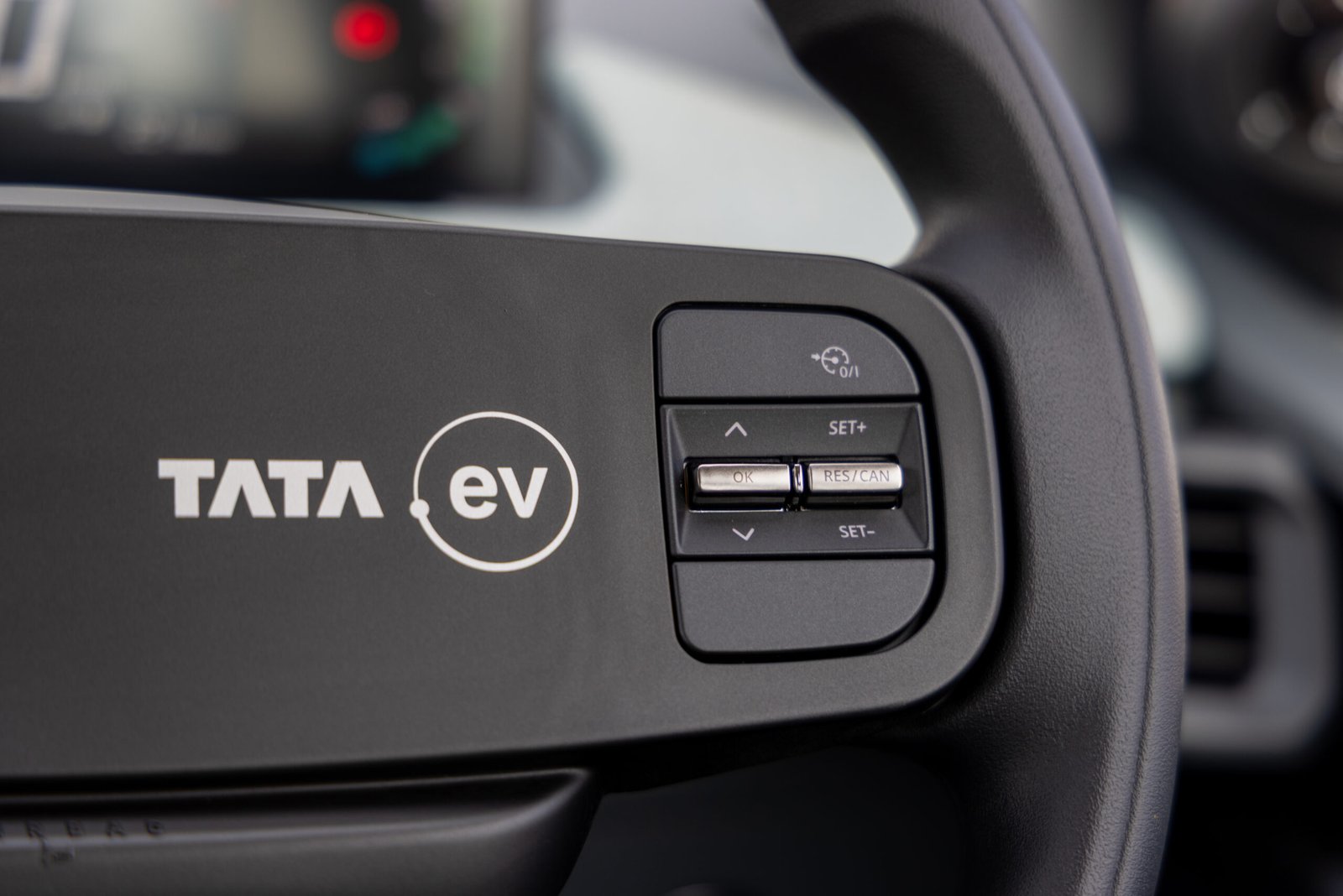
The interior is where Tata has done the most work, and it shows. The old cabin was the weakest part of the Tiago EV’s case. You’d sit in this forward-thinking electric car and be reminded immediately that cost had been cut somewhere. That’s been addressed. There’s a redesigned dual-tone dashboard now, with a free-standing 10.25-inch touchscreen and a new TFT instrument cluster with Bluetooth support. The screen is responsive and high-resolution, with none of the lag that plagues screens at this price. The rotary drive selector is a significant improvement over the old setup, and the centre console is considerably cleaner for it. The two-spoke steering wheel returns but with a Tata.ev logo, and the gloss piano black trim around it has been swapped for a matte grey that looks much better. Small detail, right call. The AC vents have been repositioned too, angled toward the front passengers rather than just into the centre of the cabin. The kind of thing you only notice when it actually works on a hot Mumbai afternoon.
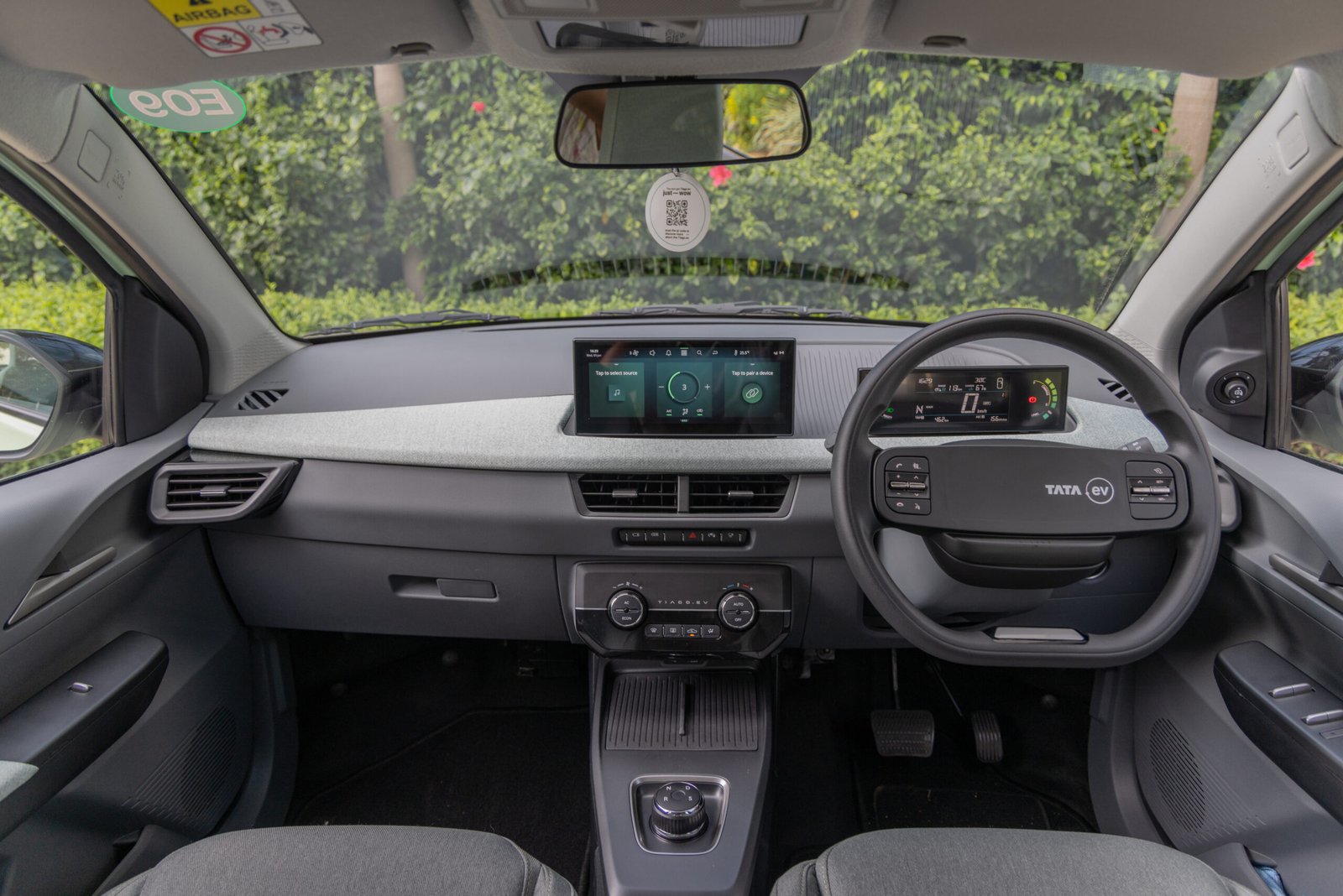
The feature count at this price deserves attention. Wireless CarPlay and Android Auto, automatic climate control, connected car tech with over forty functions, cruise control, rear AC vents, a cooled glove box, auto-folding ORVMs, a height-adjustable driver’s seat. The grey fabric upholstery and the variety of materials across the cabin show more thought than you’d expect. This isn’t a premium car and it doesn’t pretend to be. But the fabric seats in particular are well chosen. For the kind of heat we deal with in this country, I’d take good fabric over cheap leatherette every time.
Safety has had the most dramatic upgrade. Six airbags are now standard across the entire range, up from two on the outgoing car. That’s not a spec-sheet footnote. It’s a meaningful policy shift that most rivals here haven’t made. Add the 360-degree camera with multiple viewing modes, a blind-view monitor, ESP with traction control, hill-hold assist and TPMS, and you have the strongest safety package in the segment by a clear margin.
Exterior design updates to the Tata Tiago EV
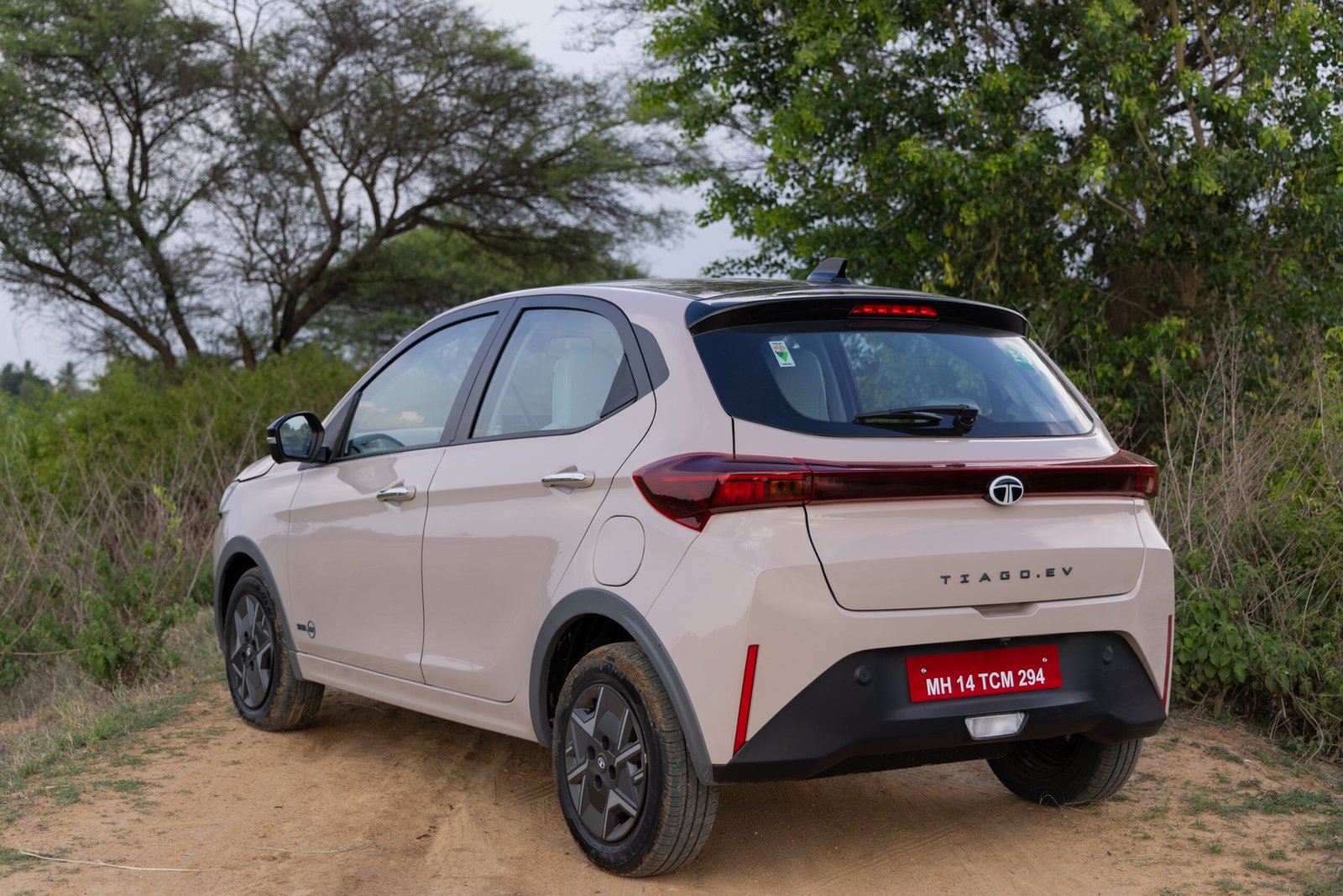
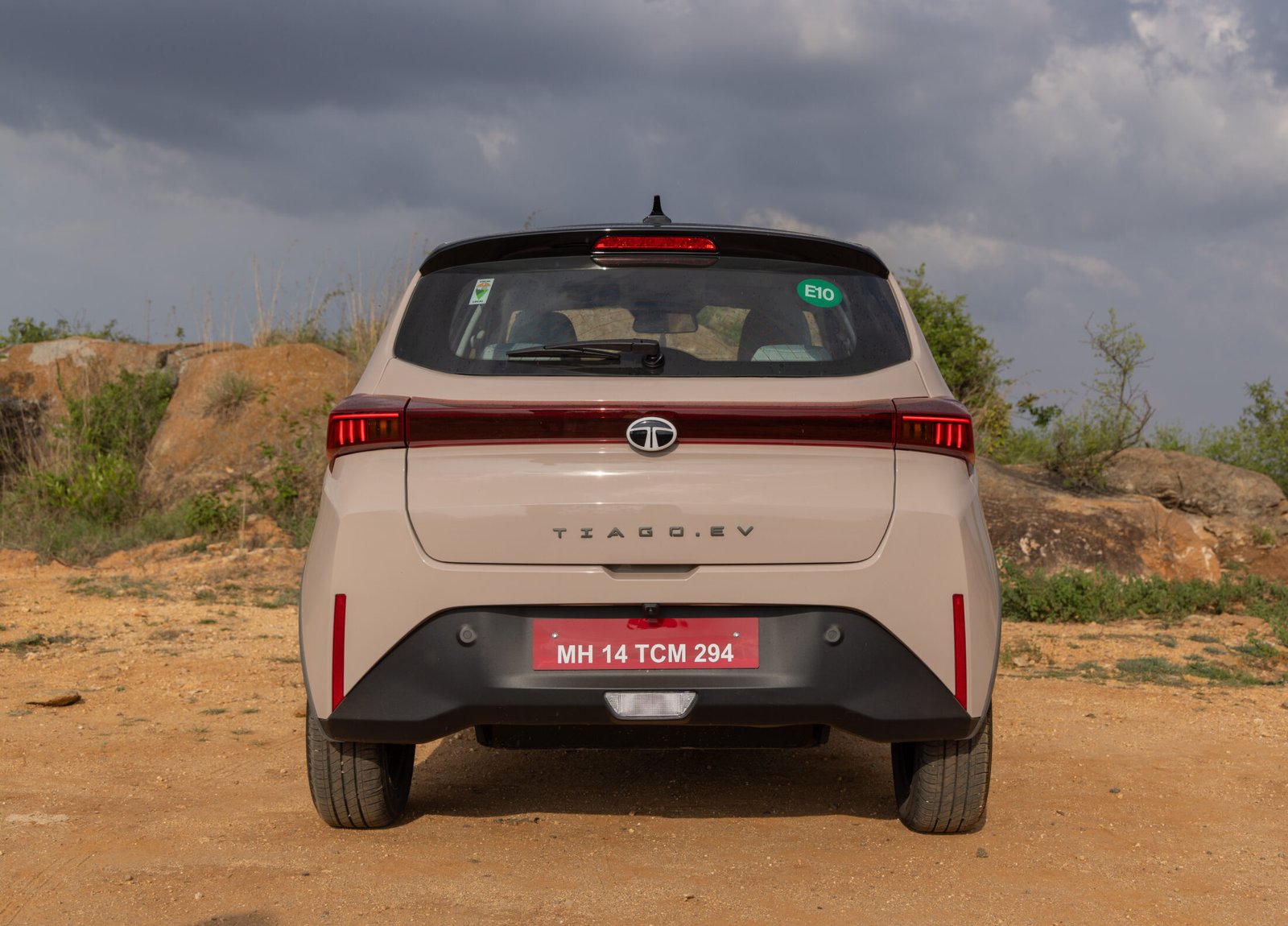
On the outside, the EV shares most of its updated visual language with the new ICE Tiago. Sharper front end, more upright headlamps, a resolved face that I think will age better than the rounder outgoing design. What distinguishes it from the petrol car are deliberate details: a closed-off body-coloured grille, revised bumper with faux air vents at the edges, new 14-inch wheels with contrasting wheel arch cladding, connected LED tail-lamps. It doesn’t try to announce itself as an EV loudly, which suits it. I had the car in Sobo Surge, a warm, muted shade that sits somewhere between orange and beige. I’ll be direct: it’s not one I’d choose. It photographs better than it looks in person and reads flat in certain light. The Pangong Pulse is the colour that works on this shape. But there are six options and the palette is more interesting than this segment usually gets.
Performance and dynamics
On the road, the Tiago EV delivers the same exceptional ride quality as the ICE car, possibly better. The suspension feels a little softer here, which means it’s even more absorbent over the broken tarmac and crater-sized potholes that define city driving in India. The trade-off is some additional body roll through corners, more than the ICE car, but that’s a trade most buyers in this segment will happily make. In traffic, the electric powertrain makes everything simpler: no clutch to manage, instant response, and none of the three-cylinder grumble under hard acceleration. It’s just easier to drive.
Two battery options: the 19.2kWh making 61hp and 110Nm, and the 24kWh making 75hp and 114Nm. MIDC figures are 226km and 285km respectively, but plan around Tata’s own C75 real-world numbers: 160 to 170km on the smaller pack, 205 to 215km on the larger. The 19.2kWh is a city car, plainly. The 24kWh works for most daily use with some planning on longer stretches. Charging is forty percent faster than before: 100km of range in 18 minutes, and both packs from ten to eighty percent in 35 minutes on a 30kW DC fast charger. The 24kWh does the 0-60 in 5.7 seconds, which is quick enough to be useful without being a talking point.
The 24kWh variant now comes with a lifetime, unlimited-kilometre battery warranty for the first registered owner. If you’ve been sitting on the fence about an EV because you weren’t sure what the battery would look like in eight years, that warranty removes the concern entirely. The 19.2kWh continues with an eight-year, 1.6 lakh km warranty.
Verdict
The Tiago EV was already a reasonable entry into Tata’s electric ecosystem. This update makes it a genuinely strong one. Better interior, stronger safety spec, faster charging, and a price that’s gone down rather than up. If your daily driving fits within the range, and for most city buyers it does, the argument here is hard to counter.