

When the Tata Punch arrived in 2021, the automotive market was in a strange state of flux. While most manufacturers were playing it safe, Tata released a vehicle that refused to be pigeonholed. It looked like an SUV, handled bad roads like one, and eventually carved out a niche that has remained largely uncontested. Fast forward to 2026, and the micro-SUV king has received a comprehensive makeover.
Design
The first thing that grabs you about the 2026 Punch is how much it has matured visually. It has shed the slightly bubbly persona of its predecessor in favor of a look that mirrors its larger siblings like the Harrier and Safari. The lighting architecture is the star of the show. You get vertically stacked projector headlamps that give the car a much taller appearance. Above them, the redesigned LED Daytime Running Lights are joined by a sleek, illuminated strip that spans the width of the hood.
The rear follows a similar connected philosophy. The taillamps now feature a continuous light bar, a design trend that has become the industry standard for 2026. The 16-inch alloy wheels have a diamond-cut finish that complements the sharper creases on the side panels. And the design updates do work well for the Punch
Ride and Handling
What has always set the Punch apart is its ability to ignore the quality of the road beneath it. Most small cars feel fragile when they hit a pothole, but the Punch feels like it was built to find them. The suspension tuning remains the highlight of the package. Whether you are tackling a gravel path or a highway expansion joint, the 193mm of ground clearance and the robust damping ensure the cabin remains isolated from the chaos outside.
The packaging also remains a masterclass in ergonomics. The doors still swing open to a full 90 degrees, making ingress and egress remarkably easy for all age groups. Tata has also worked on the seat cushioning. The fabric now has a more premium texture, and the added under-thigh support in the rear makes it a much better companion for inter-city journeys.
Engine and Performance
For five years, the primary criticism of the Punch was its lethargy. The original 1.2-litre naturally aspirated engine was fine for grocery runs, but it lacked the lungs for the open road. The 2026 facelift fixes this by introducing the turbo-petrol engine from the Altroz.
This new heart produces 120 PS and 170 Nm of torque. This is a transformative change. The car no longer feels like it is struggling to keep up with traffic. Instead, it surges forward with a confidence that makes highway overtaking a stress-free affair. The power delivery is linear, and while the three-cylinder thrum is still present, the performance gains are significant.
That said, the new turbo-petrol is only available with a manual gearbox.
| Engine | 1.2L Revotron (NA) | 1.2L i-Turbo Petrol | 1.2L iCNG |
| Power | 88 PS | 120 PS | 73.5 PS (in CNG mode) |
| Torque | 115 Nm | 170 Nm | 103 Nm (in CNG mode) |
| Transmission | 5-Speed MT / AMT | 5-Speed MT | 5-Speed MT / AMT |
Perhaps the most intelligent update for 2026 is the pairing of the iCNG technology with an Automated Manual Transmission (AMT). Historically, choosing a CNG car meant sacrificing your left leg in heavy traffic. By offering an automatic option for the CNG variant, Tata has targeted the quintessential urban commuter.
Driving this version through congested city centers is a revelation. The packaging ensures you still have a usable boot, and the AMT takes the fatigue out of stop-and-go crawls. You will notice the typical AMT head-nod during gear changes, but in the context of city traffic, the trade-off for convenience is well worth it.
While the steering wheel now features paddle shifters, they are largely decorative in the AMT models. The gearbox logic is not fast enough to keep up with manual inputs, so it is best to leave it in ‘D’ and let the car do the thinking.
Interior design and features
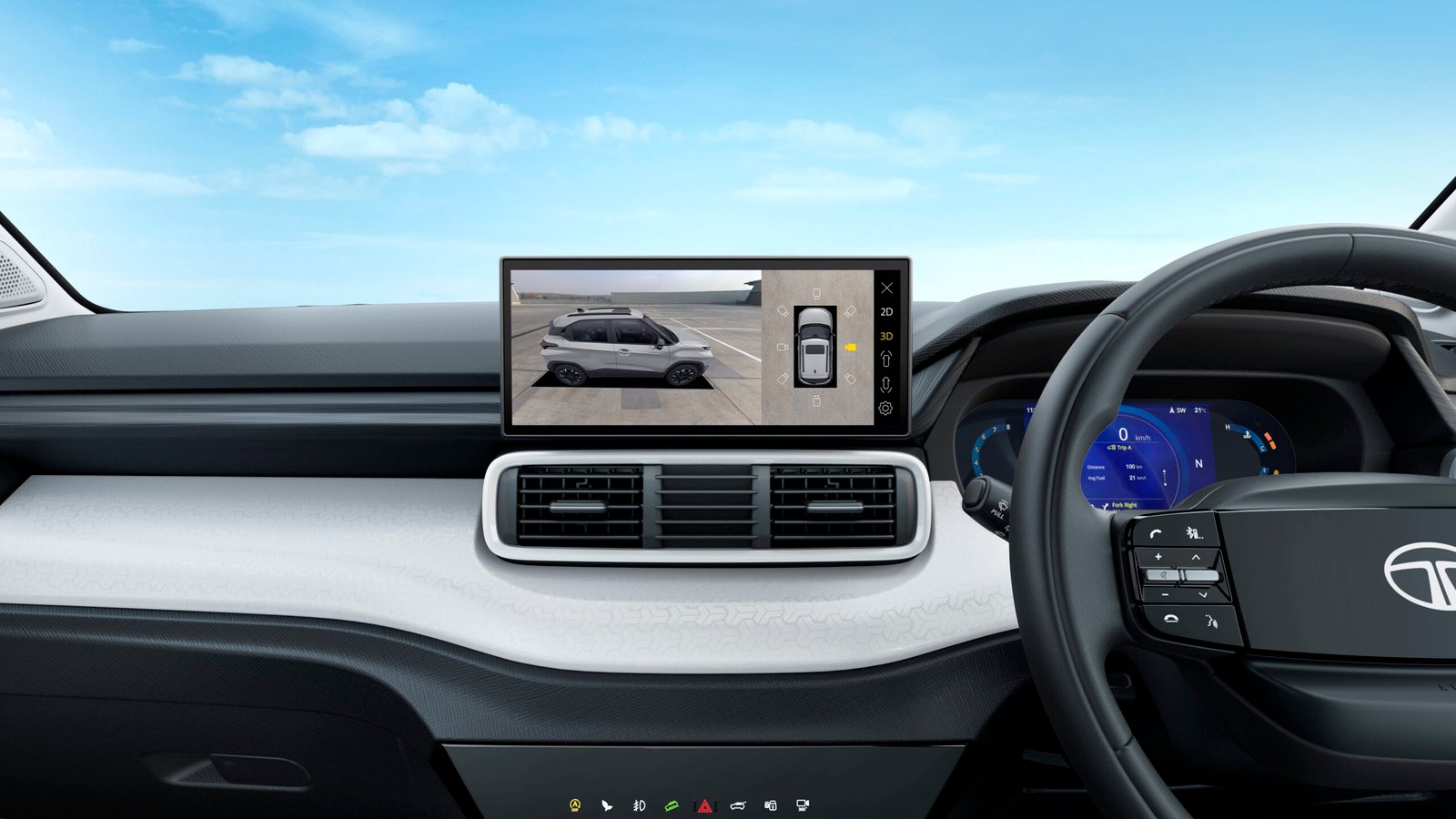
The interior has moved a few steps up the premium ladder. The center stage is taken by a 10.25-inch Ultra HD touchscreen that is surprisingly fluid. It supports wireless connectivity and provides a crisp feed for the new 360-degree camera system. Other modern essentials have been tucked in as well, including a 65W fast-charging port and a built-in air purifier.
Safety, as always, is where Tata takes a stand. Six airbags are now standard from the base trim upward. When you combine that with a 5-star safety rating and the inclusion of Electronic Stability Control (ESC), the Punch remains the most reassuring vehicle in its price bracket.
The Rough Edges
No car is without its quirks, and the 2026 Punch has a few that might test your patience. The move to a touch-sensitive panel for the climate control is a classic case of form over function. It looks beautiful in the dark, but trying to adjust the temperature while driving is difficult.
Additionally, the implementation of the Blind Spot Monitor needs a software patch. Every time you use your turn indicator, the camera feed takes over the screen. If you are using navigation at a complex intersection, your map disappears right when you need it most.
Conclusion
The 2026 Tata Punch does not try to be a different car. It simply tries to be the best version of itself. By adding the turbo engine, Tata has erased the slow label that previously haunted the brand. By adding the CNG-AMT combo, they have provided a solution for the modern city dweller who is tired of shifting gears.
With a price range between Rs 5.60 lakh and Rs 10.54 lakh, it covers a massive spectrum of buyers. It is rugged, it is safe, and it finally has the muscle to match its aggressive looks.