

I am not the target audience for all the nostalgia-themed marketing leading up to this first drive of the new Tata Sierra. Frankly, I have never sat in the ‘OG’ Tata Sierra. A large chunk of car buyers today haven’t either. The sepia-toned storytelling around the Sierra doesn’t really do much for me. It was a chapter of history I respected but didn’t feel.
But when Tata first unveiled the production version of this car, I had to sit up in my seat. I had to take notice.
Because this, on paper, is not a restomod or a lazy cash-grab on a heritage badge. This is a thoroughly modern SUV built from the ground up. And looking at the spec sheet, it is clear that Tata has thrown everything and the kitchen sink at it.
The Look
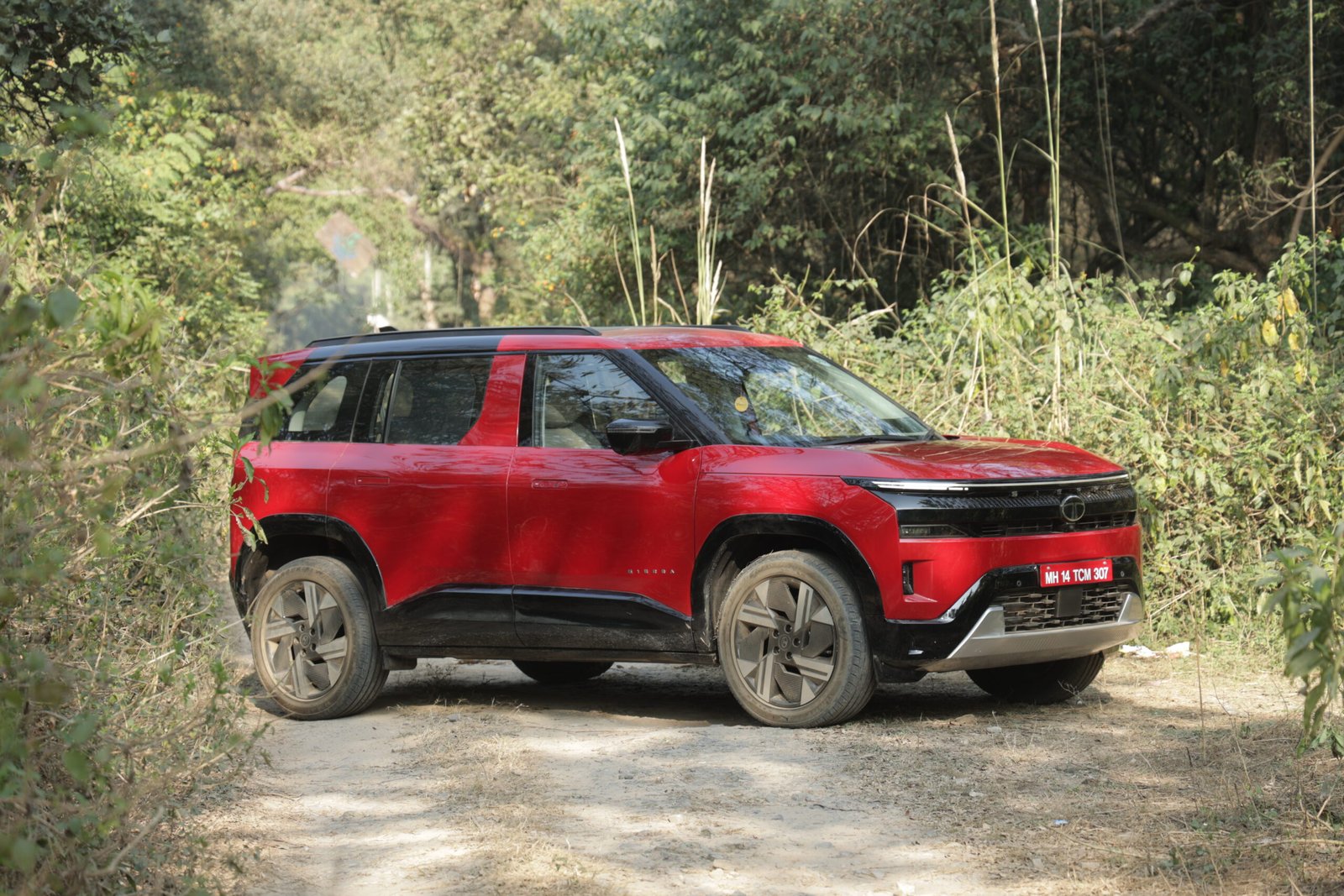
Let’s get the obvious out of the way immediately. This is a great looking car.
In this deep, lustrous red, it will turn heads. It commands attention not because of what it was, but because of what it is. I am not one to care for the past, but I have to admit that the original Sierra had a bunch of bold design choices. This new iteration takes that boldness and pushes it several steps forward.
I am genuinely impressed by the level of commitment Tata’s engineers and designers have shown to the design brief here. Look at the face. These headlamps are razor-sharp. At just 17mm, they are the slimmest in India. The DRL is a continuous, unbroken line of light—the longest in the country. It gives the car a futuristic, digital face that looks ready for 2030, not just 2025.
Come to the side, and the narrative changes from digital to architectural. The surfacing is immaculate. There is a distinct Land Rover influence here in the way the panels catch the light—flat, muscular, and devoid of unnecessary creases. It adds massively to how premium the car looks.
We can no longer have a full glass house like in the original Sierra. In 2025, we care about things like crash safety standards and structural rigidity. But Tata has navigated this cleverly. They have blacked out sections to mimic that wrap-around glass effect. It is a visual trick, but it works.
At the rear, the story continues. The wide haunches give it a planted, muscular road presence. The huge DRLs bookend the design perfectly. It stands tall. It looks massive. Dimensionally, it pushes the boundaries of the segment, riding on large wheels that fill the arches with authority. It has presence, and a certain swagger.
The Cabin
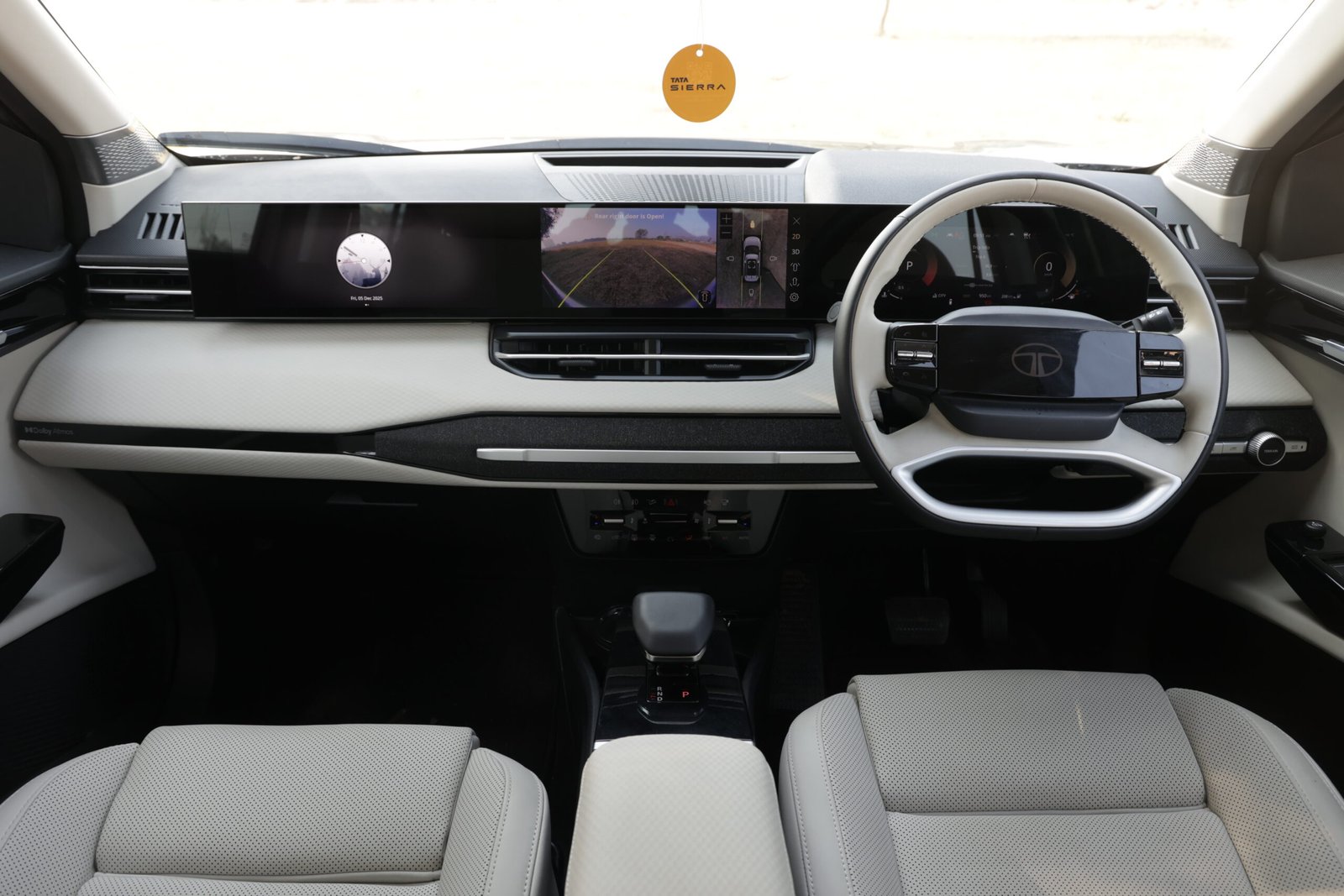
That commitment to the brief is not restricted to the exterior. It flows inside.
I want to start with the sense of space. It begins with the sunroof. It is the largest in the segment. It lets in a flood of light that makes the already large cabin feel cavernous. This is the most spacious car in its class to begin with, and the glass roof just amplifies that airiness.
You climb into a commanding driving position. There is a genuine sense of occasion in this cabin. The three-screen layout is a big reason why. It looks tech-forward without being overwhelming. The displays are crisp, the touch response is fluid, and Tata seems to have ironed out a lot of the early issues with its tech. It comes packed to the gills with features, with the three screens controlling a large chunk of them. The screens, 12.3-inch units for the infotainment and front-passenger display and 10.25-inch for the instrument cluster are a step up from anything else in the segment. The commitment to the digital real-estate has meant that there have been omissions elsewhere. For instance, the electronic parking brake switch has been removed, which irks me somewhat.
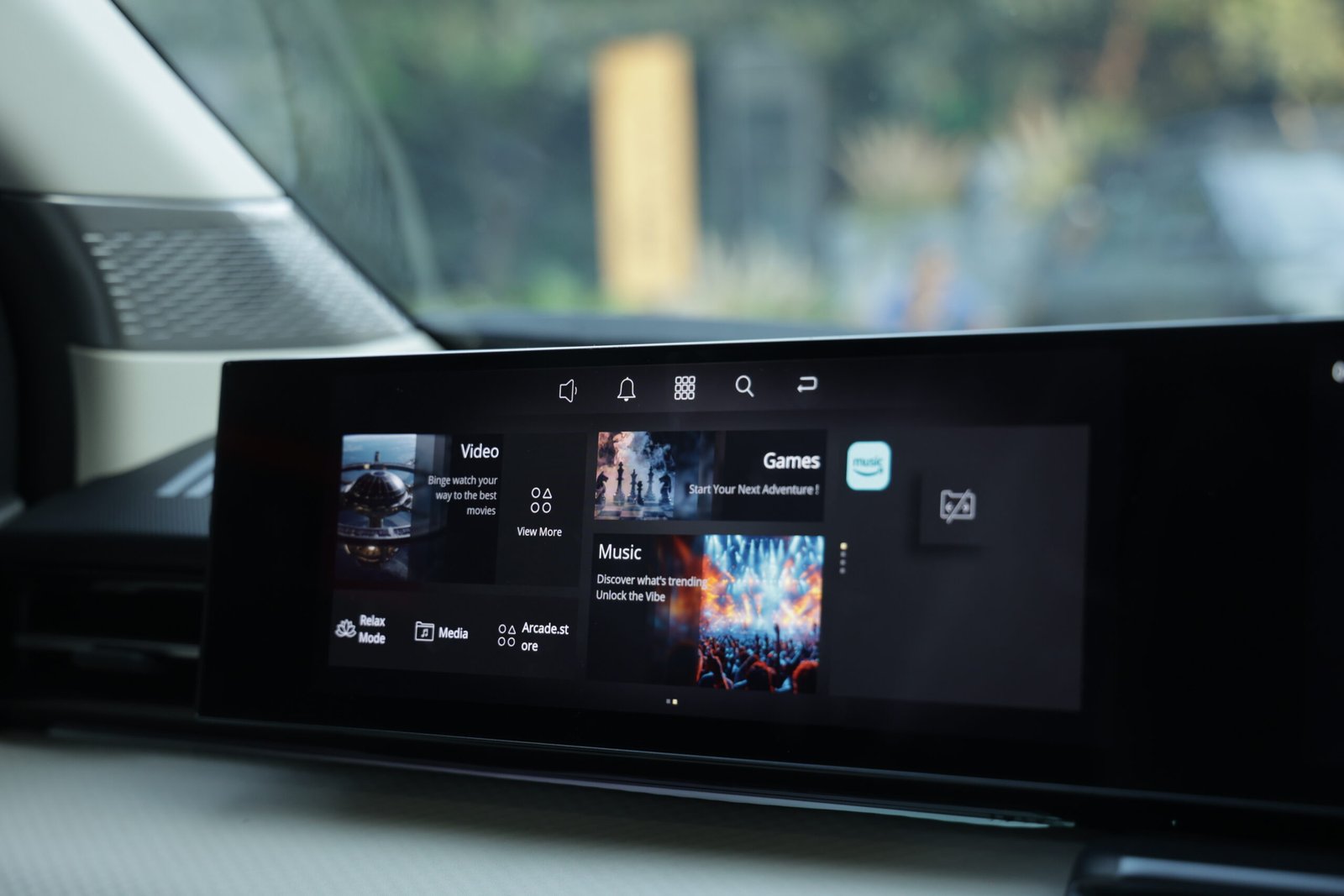
Audio duties are handled by a 12-speaker system from JBL with Dolby Atmos support. It is punchy, clear, and immersive. Tata has also worked on the seating comfort. The ergonomics feel sorted here, except for one annoying, easy-to-address issue that Tata somehow refuses to fix. I will get to that later.
The seats at the front are supportive, and the visibility is excellent. You feel like the captain of a very modern ship. Even at the back, there is loads of legroom and headroom, the seats recline and there is a decent amount of under-thigh support as well. This Tata is clearly the class benchmark in that regard.
However, it is not all perfect. While the material quality is generally high with soft-touch points in the right places, there are issues with fit and finish. I noticed inconsistent stitching, panel gaps, and misaligned sections, with different units having slightly different issues. I hope these minor gripes are fixed before the cars roll out to customers.
The Drive
This is where the real surprise lies. We started off driving the 1.5-litre Hyperion turbo-petrol engine. It produces 160hp and 255Nm of torque. It is mated to a 6-speed torque converter automatic from Aisin. I have to say this: This is the powertrain to get.
For the longest time, Tata hasn’t made a really good petrol powertrain for its ICE vehicles. Their diesels were legendary, but the petrols always felt like a compromise. They were either underpowered, thirsty, or unrefined. This, I am very happy to report, changes that.
The 0-100kmph sprint is dispatched in a smidge over 9 seconds. That is brisk. But numbers only tell half the story. It is the way it delivers that power that impresses. It feels responsive all through the rev range. The power delivery is linear, predictable, and strong.
The Aisin gearbox is a revelation for a Tata product. It is smooth. It is intuitive. It doesn’t hunt for gears. It masks the turbo lag effectively and makes the car feel eager. Whether you are pottering around in city traffic or dropping a gear for a highway overtake, the transmission is always in the right cog. But, Tata simply refuses to get rid of the e-shifter for the gearbox. It objectively degrades the overall driving experience. During my time using it, I was constantly worried about the shifts not having been registered. That gear lever simply has to go.
Look past that, and the drivetrain makes the Sierra such a big step up. Great job, Tata. You finally have a petrol heart that matches the chassis and suspension package.
I also spent some time driving the diesel mated to the same 6-speed torque converter from Aisin. It is also a 1.5-litre unit, but clearly not as refined as the turbo-petrol. It also feels underpowered when you have had the chance to drive the turbo-petrol. The diesel would definitely be more fuel-efficient, but it isn’t as versatile a motor as the turbo-petrol is.
Ride and Handling
Speaking of the chassis, the new ARGOS platform shines. The ride quality is exemplary. Tata has developed a reputation for suspension tuning that suits Indian roads, and all of that expertise shines through here. It swallows bad roads with a muted thud. It feels robust. It feels expensive.
Sure, there is some body roll. You are driving a tall, boxy SUV, so physics will have its say. But on the whole, this might be the best ride and handling balance in the segment. It doesn’t float like a boat, nor does it crash through potholes. It finds that sweet spot of compliance and composure. It is very much like the Safari and the Harrier in that regard.
However, the package is not entirely without fault. The steering isn’t as accomplished as the chassis and suspension. It lacks feedback. It is light and easy for parking, which is great, but at speed, it feels a bit disconnected. Still, it is not like most of its competitors are doing great on that front. So, it is something I am willing to overlook.
Verdict
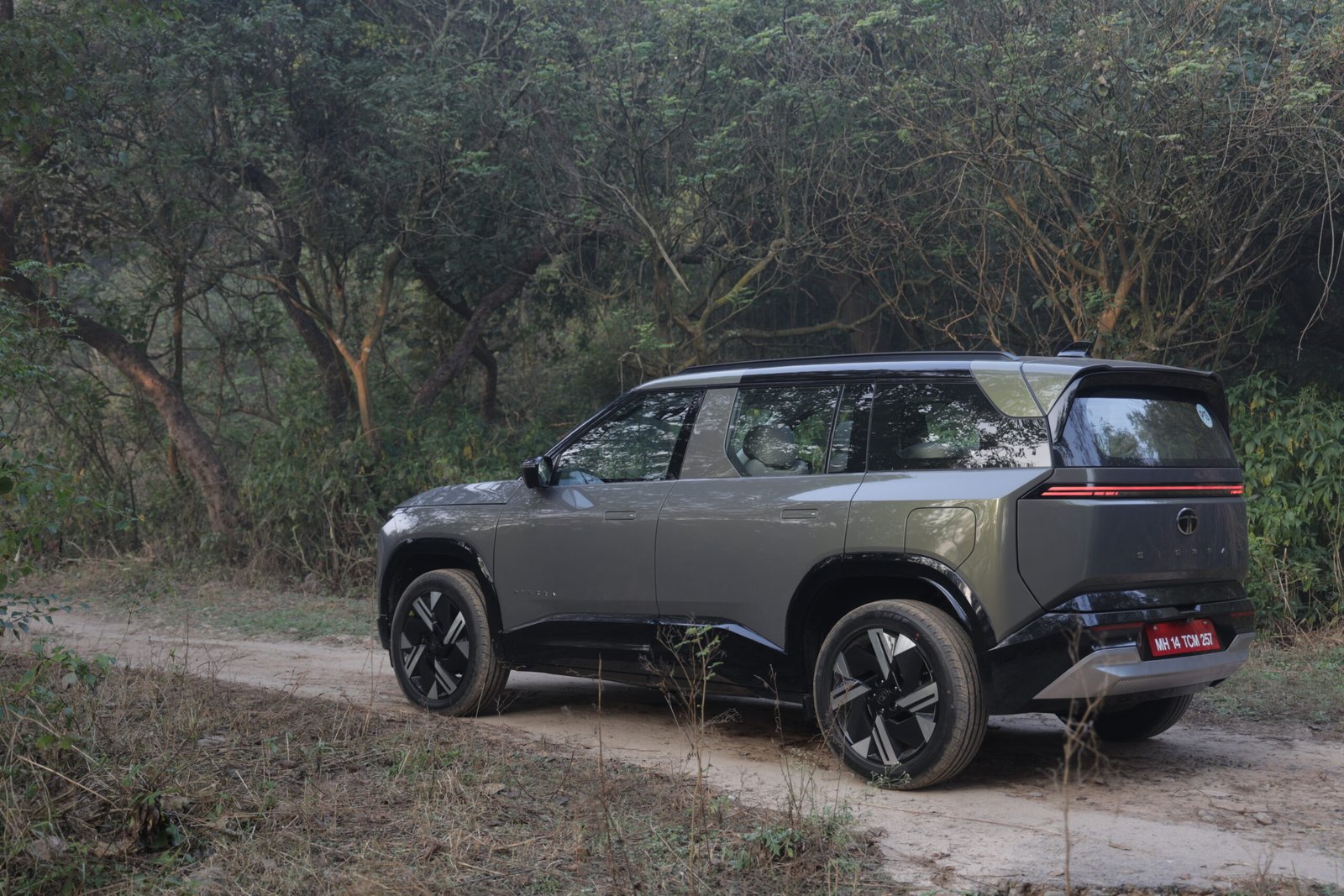
The Tata Sierra returns not as a ghost of the past, but as a challenger for the future. It is a complete package. It has the looks to stop traffic. It has the tech to keep you entertained. It finally has a petrol engine that is worthy of the chassis and suspension. And it rides with a maturity not seen yet at this price point. Prices start at Rs. 11.49 lakh (ex-showroom) for the very well-equipped base variant, and I think the top-spec variant will be around the Rs. 22 lakh mark.
The ‘Sierra’ badge means something in India. It’s a bit of an icon. But this car doesn’t rely on that badge to sell itself. It stands on its own merits. It is a car for the enthusiast who has grown up. Someone who needs the space for a family, the comfort for a commute, but still wants a machine that makes them look back after they’ve parked it.
Tata has reinvented the icon. And for once, the reality is better than the nostalgia.